

A disclosure, in the spirit of the subject. I am a member and supporter of the Wikimedia Foundation and a longstanding admirer of the project. I also work in communications and intelligence, where part of the job involves making properly declared, conflict-of-interest edit requests of the kind I describe below. And at the end of 2025 I was lucky enough to sit down with Wikipedia’s co-founder, Jimmy Wales, for a long conversation about trust, AI and the future of the encyclopedia. Some of what he told me appears here.
There is a particular flavour of frustration, familiar to anyone who has ever tried to get a legitimate, properly sourced, conflict-of-interest edit actioned on Wikipedia, that I have come to think of as the encyclopedia’s quiet tell. You do everything by the book. You declare your interest. You assemble your citations like a barrister preparing a brief, reaching for the independent secondary source rather than the convenient primary one. You place the little edit-request template at the foot of the talk page, append your courteous request, sign it with the requisite four tildes, and then you wait. And wait.
Unless you have the rare convenience of an active editor on the page, most COI requests join a centralised queue, patrolled by a small but dedicated band of volunteers. The oldest open requests in that queue tend to hover somewhere between three and four months old. Some have been seen wearing the dust of a year or more. Somewhere around week six, you begin to suspect that the encyclopedia which now functions as the closest thing humanity has to a shared factual substrate is being maintained by roughly the number of people it takes to staff a mid-sized garden centre.
That suspicion is the puzzle this article sets out to solve.
On the one hand, Wikipedia has never mattered more, for reasons I will come to that have everything to do with artificial intelligence and almost nothing to do with its readers. On the other hand, getting a careful and entirely legitimate change made to it has never felt slower. I went in believing the obvious explanation, the one most people believe: that Wikipedia is simply running out of editors, fewer hands at the tiller every year. That turns out to be wrong. What is actually happening is stranger, and rather more alarming, than simple decline. Here are four facts, with four graphs. Take them in order.
PART ONE: THE EVIDENCE
Shift one. It is not, in fact, dying
The popular narrative has a comfortable shape. Wikipedia peaked in its idealistic youth and has been bleeding contributors ever since. There is real history beneath this. The number of active editors on English Wikipedia, defined with bureaucratic precision as registered, non-bot users making five or more edits in a given month, did indeed peak in 2007 at somewhere north of 51,000, and then entered what the researcher Aaron Halfaker memorably christened the decline phase. His widely cited 2013 study traced the cause not to apathy but to the encyclopedia’s own immune system: as Wikipedia armoured itself against vandalism with bots, automated reverts and an ever-thickening hedge of policy, it became markedly less hospitable to newcomers, whose first tentative edits were now liable to be reverted by an efficient and impersonal machine. The newcomers, unsurprisingly, declined to return.
But here the data does something the narrative does not. The decline did not continue to zero. It bottomed out around 2013 to 2014, at roughly 31,000, and then it stabilised. The current figure, the one sitting on the encyclopedia’s own statistics page as I write, is around 37,000 active editors a month. Below the giddy high-water mark of 2007, yes. But comfortably above the trough, and broadly flat for more than a decade.
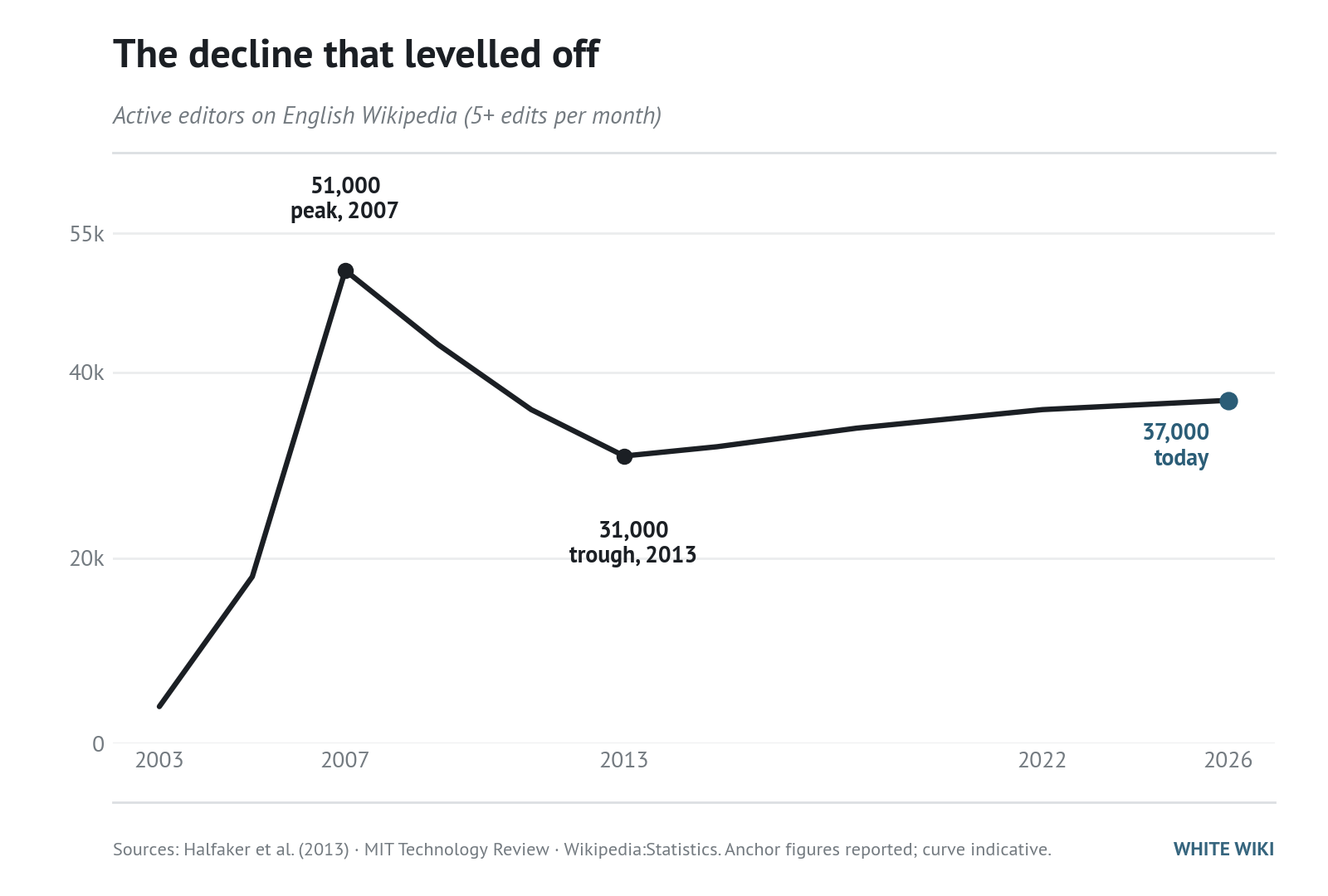
So the obituaries were premature. English Wikipedia is not dying. The patient is, if anything, eerily stable. Which raises a far more interesting question. If the workforce has held steady at around 37,000 for ten years, why does it feel, to anyone actually trying to get something done, as though there is nobody home?
Shift two. But the house has doubled
The answer is that we have all been watching the wrong number. The headcount is not the problem. The ratio is the problem.
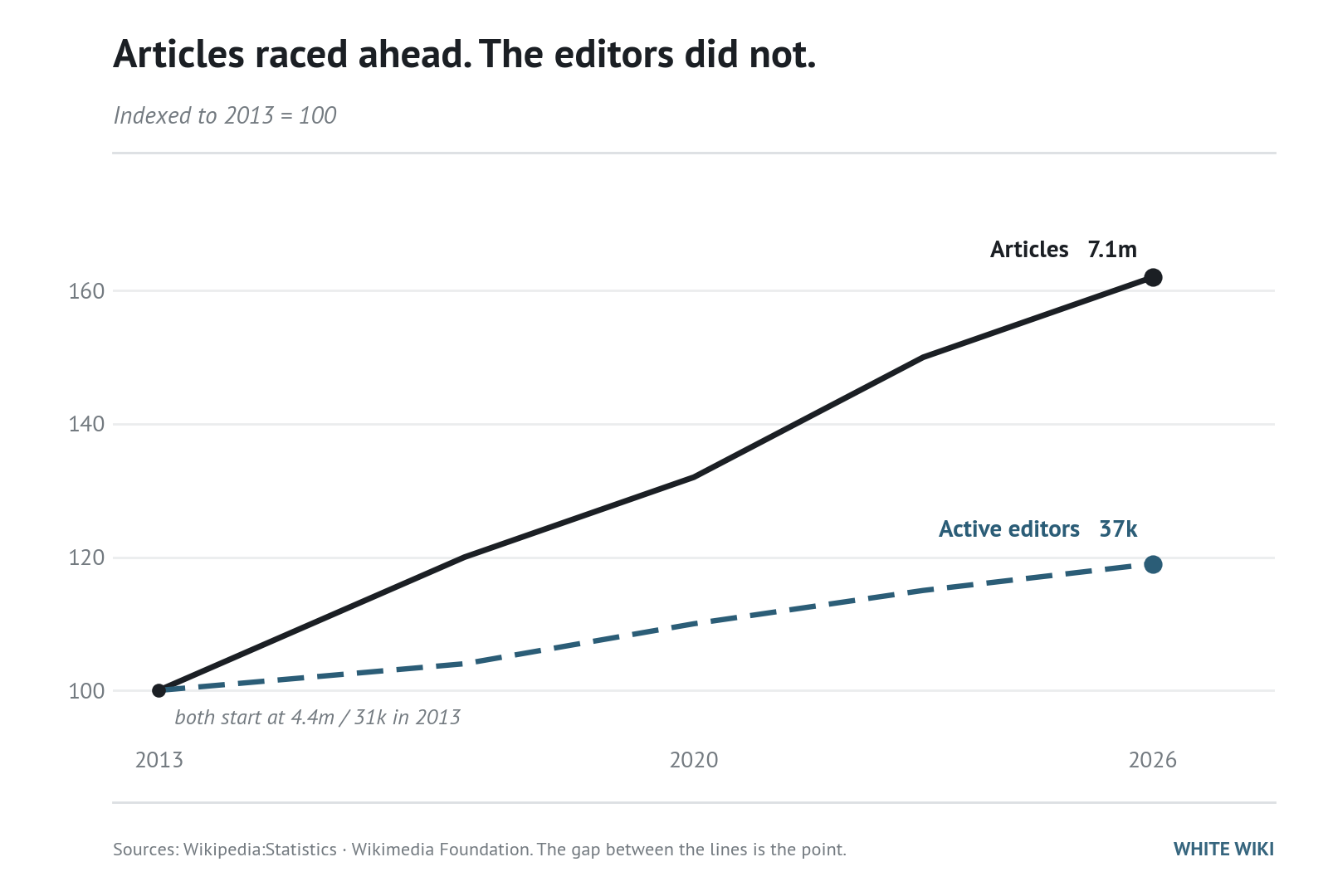
+62% Growth in English Wikipedia articles since 2013, from 4.4 million to over 7.1 million, while the active editor base has stayed broadly flat. The same staff now maintains half as much house again.
In 2013, when the decline narrative was being written, English Wikipedia held about 4.4 million articles. Today it holds over 7.1 million. The encyclopedia has grown by more than half again, nudging towards a doubling, while the body of people maintaining it has not grown at all. Every one of those new articles must be watched, sourced, defended against vandalism and decay, updated as the world turns, and dragged into line with two decades of accreted policy. The house has gained wings, attics and a great many leaking gutters, and the same modest staff is expected to keep all of it weatherproof.
It is worse than even that ratio suggests, because the labour is grotesquely concentrated. The cliche, tiresome but essentially true, is that something close to 1% of editors produce the overwhelming majority of the content. The genuinely heavy lifting falls to the very active cohort, those making a hundred or more edits a month, who number only around 3,000 - 3,500 souls in any given month. When you submit an edit request, you are not appealing to a crowd of 37,000. You are joining the in-tray of a few thousand volunteers, most of them doing this in the evenings, for free, and who were, even a decade ago, described by the Foundation’s own people as feeling beleaguered and overworked.
Shift three. And the officers have all but gone
If the editors are merely overstretched, the administrators are something closer to an endangered species, and this is where the practitioner’s frustration finds its true source. Administrators are the editors entrusted with the heavier tools and, crucially, with the authority that often decides whether a contested edit request lives or dies. They are anointed through a process called Requests for Adminship, and the collapse of that process is one of the more astonishing graphs in the whole of internet governance.
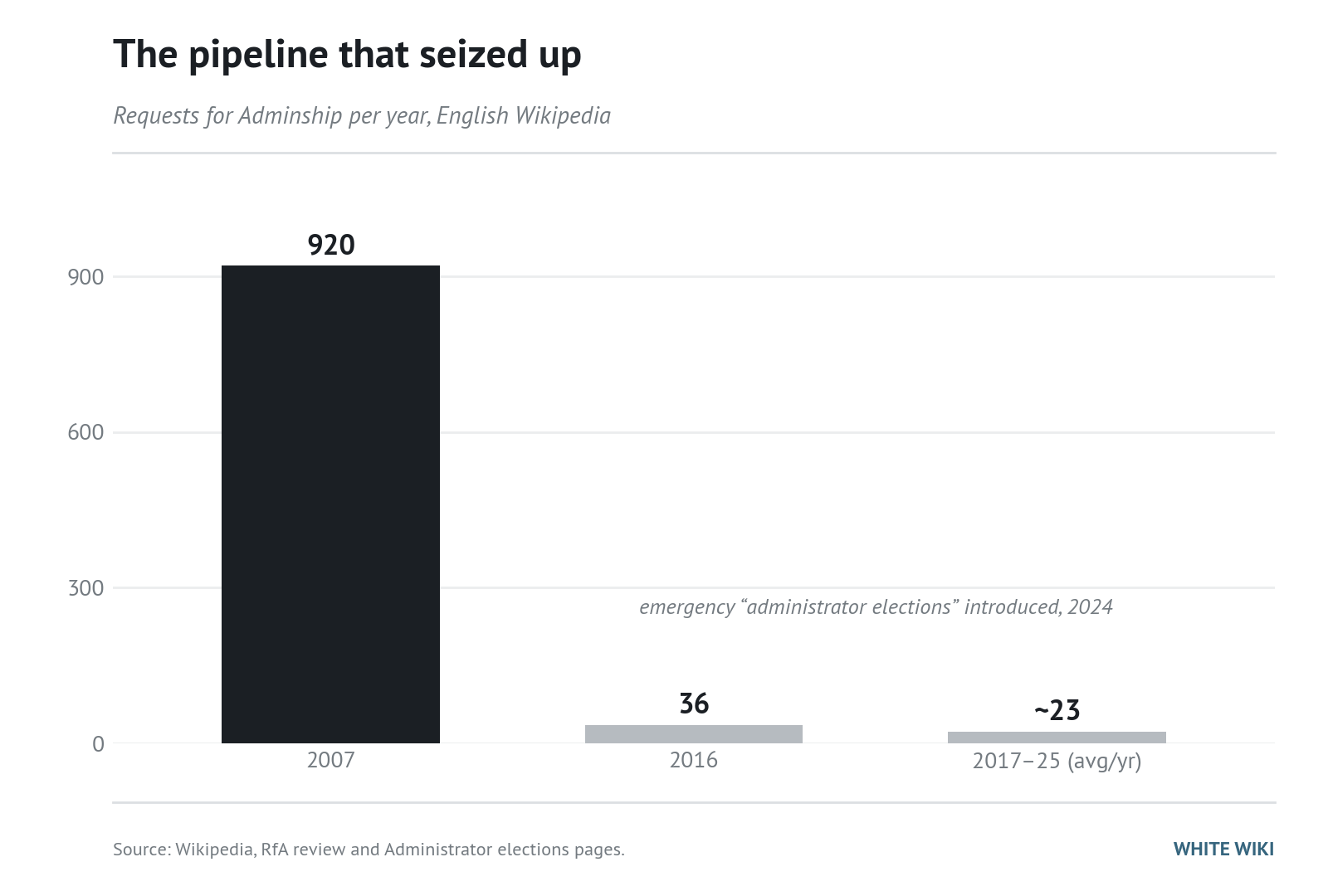
The number of administrators today stands at around 820, a figure that has drifted downward for years and which flatters the reality, since a good share of those accounts are dormant. The process had become so notoriously gruelling, so much like running a gauntlet of strangers entitled to interrogate your every edit from a decade past, that qualified candidates simply stopped putting themselves forward. Matters had grown sufficiently dire that in 2024 the community did something it almost never does: it changed the constitution, introducing secret-ballot administrator elections expressly to spare candidates the public flaying of the old process. That is not the behaviour of a healthy institution casually iterating.
Shift four. While the readers are quietly intercepted
Wikipedia has never mattered more than it does today, and the reason has nothing to do with its readers. It is because of the machines. To a first approximation, every large language model in commercial use has been trained on Wikipedia, and the Wikimedia Foundation admits that its corpus is almost always the single largest source in those models’ diets. It is probably over-represented even relative to its size, because it is mirrored so promiscuously across the web that it ends up baked into the training data several times over. One researcher, reaching for a suitably undignified image, described the whole training corpus as a giant hairball, with Wikipedia threaded all the way through it.
It does not stop at training. Wikipedia underpins Google’s Knowledge Graph, populates the knowledge panels, feeds the AI Overviews and the chatbot answers, and serves as the primary credibility checkpoint against which a Generative AI model decides whether a claim about you, your client or your company is to be trusted. When an AI confidently describes a business to a user, it is very often Wikipedia doing the talking, ventriloquised through a model that will never cite it.
And there is the rub. The machines that depend on Wikipedia are simultaneously starving it.
−23% Fall in daily human visits to Wikipedia since early 2022, from roughly 165 million to under 128 million, with an 8% year-on-year drop in 2025 alone once disguised bot traffic was filtered out. We are all still reading Wikipedia. We have simply stopped visiting it.
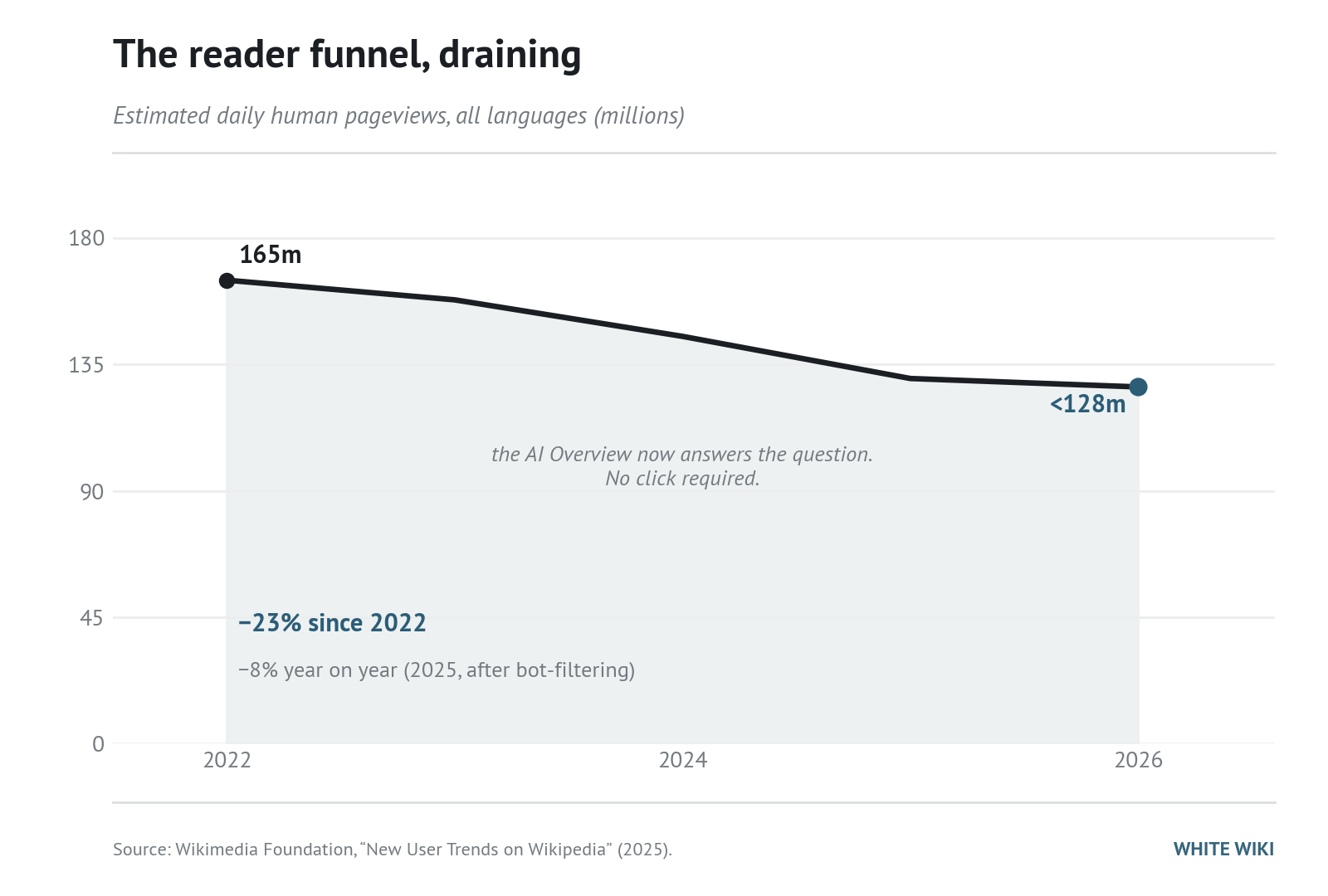
The Foundation’s own analysis puts the cause plainly: search engines increasingly answer the question directly, in a tidy package, with no click required. When I interviewed Jimmy Wales at the end of 2025, he put the same figure to me himself, the 8% drop in human visits even as bot traffic climbed, and described the disproportionate hit on a charity’s server costs as AI firms crawl the site around the clock. He was, characteristically, more sanguine than alarmed. For a charity, he argued, lost page views matter less than lost attribution; the real sadness would be a world in which the public no longer knows the knowledge came from Wikipedia at all.


That is the optimistic reading. The pessimistic reading, which the graphs above quietly support, is that readers are not only an audience but a recruitment funnel. The casual visitor who fixes a typo today is the very active editor of 2030; the reader who sees the donation banner is the reason the servers stay on. An AI layer that consumes Wikipedia’s knowledge while intercepting its readers is, in the bracing word now used across the publishing industry, parasitic. It feeds on the host while cutting off the host’s supply of nutrients. The decade of flatness on current trends, is about to get a great deal less flat.
The snake and its tail
In March 2026 the community drew a line. After a Request for Comment that had failed in various forms before, English Wikipedia voted, by a margin of roughly forty to two, to prohibit the use of large language models to generate or rewrite article content outright. The exceptions were narrow and telling: you may use an AI to copyedit your own prose, provided you check it, and to rough out a translation. You may not use it to write the encyclopedia.
The reasoning was not technophobia. It was arithmetic and self-preservation. Generating a plausible, confident, entirely fabricated paragraph now takes a machine seconds. Detecting it, verifying it against sources and cleaning up after it takes a human volunteer hours. In a community where volunteer-hours are precisely the scarce resource, that asymmetry is fatal. Wales sketched the underlying mechanism to me in plainer terms than most policy documents manage: a model simply picks the most probable next word, so the most plausible thing is not the same thing as the most true thing, and what you get, eventually, is hallucination dressed as fact. He was unambiguous that the Foundation should never put AI-written text in front of readers without a human checking it first. The editors went further still, and named the deeper trap: the compounding loop in which hallucinated text slips into an article, is scraped into the next training run, and re-emerges from a future model as apparent fact, complete with a citation trail that loops back, eventually, to the lie. The serpent eating its own tail. The straw that broke the camel’s back, fittingly, was an autonomous agent that had taken to authoring articles on its own initiative.
PART TWO: THE CHALLENGE TO COMMUNICATIONS
So gather the four shifts together, because their sum is the answer to the puzzle I began with.
A flat workforce. Maintaining a doubled encyclopedia. With a collapsed officer class. And a reader funnel now being drained by the very machines that depend on the output.
Your conflict-of-interest edit request does not languish because Wikipedia is hostile to you, nor because you have done it wrong. It languishes because it is the downstream symptom of every one of those graphs at once. It sits near the bottom of a months-long queue tended by an over-stretched few who are also, as of this spring, fighting a war against machine-generated content. That is the whole mystery, solved.
For those of us in the reputation and intelligence trades, this rearranges the problem in three uncomfortable ways.
The stakes have inverted and risen. It used to be that an error or an unflattering line on a Wikipedia article cost you one webpage, read by whoever happened to land on it. That is no longer the unit of damage. Because Wikipedia is now the credibility checkpoint for the models, an outdated or wrong article propagates outward into AI Overviews, chatbot answers, voice assistants and knowledge panels, becoming the machine consensus about your client, repeated confidently and without attribution to a public that increasingly never visits the source. The article is no longer a page. It is a seed crystal for everything the machines will say about you next.
The legitimate route has narrowed exactly as the stakes have widened. This is the cruel scissors of the whole situation. The proper, disclosed path, the edit request made under the paid-contribution rules, depends entirely on the attention of experienced editors and administrators, which is the one resource every graph above says is shrinking in effective terms. The correct way to do this has never been slower. Meanwhile the improper shortcuts, the undisclosed account, the quiet direct edit, are more dangerous than they have ever been, because the community’s new vigilance against both conflicted editing and AI-generated text means anything that looks engineered is more likely to be caught, reverted and pinned to your client’s name in a place that the models will then dutifully learn from.
You cannot simply automate your way around the bottleneck. The obvious temptation, in 2026, is to have a model draft the polished article and submit it. That door has just been bolted. Generating or rewriting article content with an LLM is now against policy and actively policed, and while reviewers have sensibly agreed that prose merely reading like AI is not by itself a hanging offence, the burden of suspicion has shifted. The machine that made your job look easy has made the gatekeepers trust the gate less.
What actually works, then, is unglamorous and worth stating plainly. It is also, more or less, what Wales himself described to me as the approach that succeeds. Do not try to turn an article into a PR puff piece; that, he was frank, is simply not on the menu. Instead, point out where a published fact or the other half of a story has been left out, supply the reliable source, and let the evidence carry it. Arrive with the work finished: a clearly formatted, drop-in change, sourced to independent secondary material rather than the company’s own announcements, and obviously in service of a better encyclopedia rather than a shinier subject. And build a reputation.
On Wikipedia, as Wales put it to me, your pseudonym is your reputation, earned slowly through consistent and visible good behaviour; editors listen to the people they have learned to trust, and revert the ones they have not. The scarce resource is volunteer attention, so the winning move is to spend as little of it per request as possible. There is no growth hack for an under-resourced platform. There is only making the volunteers’ lives easier, and waiting your turn.
The authority of Wikipedia has never been higher. The number of hands holding it up has never been more precarious relative to the weight. Those two lines cannot keep travelling in opposite directions forever.
The lesson for anyone whose work touches Wikipedia is therefore not to treat its remaining editors as obstacles to be routed around, but as the overstretched custodians they actually are, of a thing far more important than the average comms brief allows. It is also, I think, the lesson Wales kept returning to in our conversation: trust is not a static asset but a thing built, slowly, through purpose, evidence and openness, and just as easily lost. The least we owe the people still doing that building, before we ask the machines anything else, is to remember whose answers we are really receiving.