

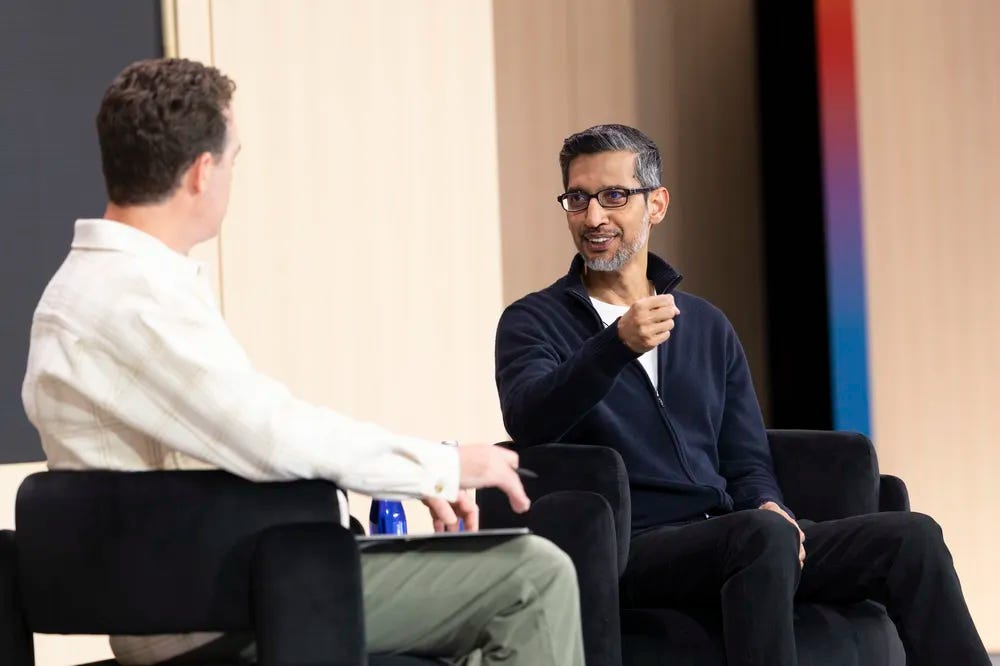
A fortnight has passed since Sundar Pichai stood up in Mountain View on 19 May and announced that we are now “firmly in our agentic Gemini era.” A fortnight is long enough for the dust of the hot takes to settle, and long enough to separate the parts of the keynote that genuinely move the ground beneath corporate communications from the parts that merely furnish a week’s worth of LinkedIn updates.
I have spent the time since wading through the sessions and the largely tedious industry reaction. The loud quarrel of the past two weeks, the one pitting evangelists who pronounce Search Engine Optimisation (SEO) dead against purists who dismiss Generative Engine Optimisation (GEO) as a manufactured buzzword sold to the credulous, is the wrong one. Both camps are still arguing about discoverability: how a brand gets found. I/O 2026 was not, at bottom, about how you get found. It was about who now owns the act of discovering and understanding on the public’s behalf, and what that ownership does to the economics and the surveillance of reputation. That is a different conversation, and for our profession a far more uncomfortable one.
Let me start with the facts, because they are better than the rhetoric.
What actually happened
AI Overviews now reaches over 2.5 billion monthly users. AI Mode has crossed one billion monthly users in roughly twelve months, having grown something like tenfold since the previous autumn. Google’s own framing is the part worth dwelling on: queries are more than doubling every quarter, and total search volume reached an all-time high last quarter. People who use the AI features are not searching less. They are searching more, because the friction of composing the perfect keyword string has been abolished.
Around those numbers Google announced four things that matter to anyone who manages a reputation for a living.
The search box itself has been rebuilt for the first time in over twenty-five years. It is now multimodal by default, accepting text, images, files, video and even open Chrome tabs, and it reasons across all of them at once. AI Overviews and AI Mode have been merged into a single flow, so a user drifts from a results page into a conversational back-and-forth without ever choosing to. AI Mode has not been made the formal default, but the behaviour is now so close to default that the distinction is largely academic.
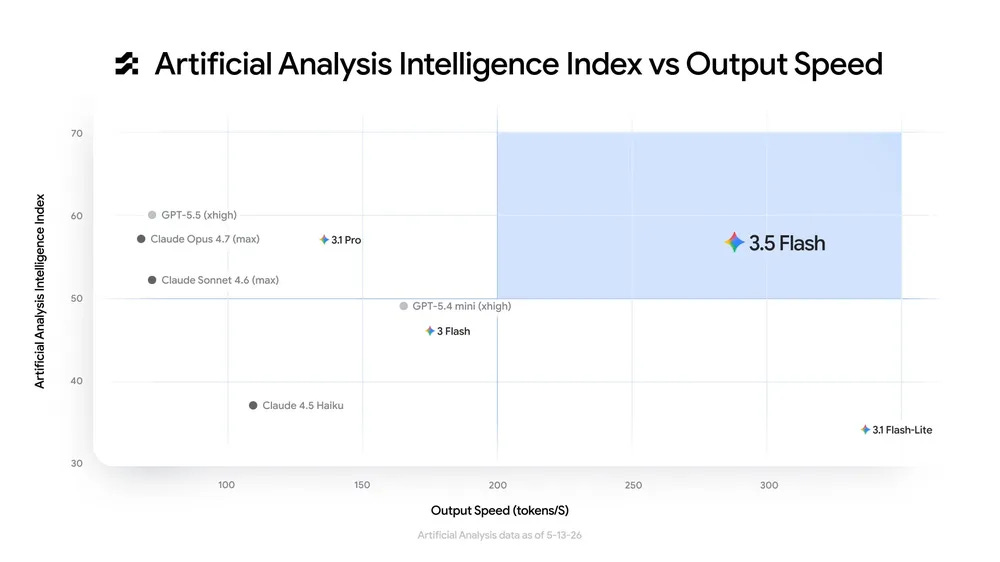
The model underneath it all is Gemini 3.5 Flash, now the global default in AI Mode, fast and cheap enough to run agentic tasks at the scale of the entire search index.
Google introduced background information agents. These are autonomous systems that sit inside Search and monitor a topic continuously, looking across blogs, news, social posts and live data, then surfacing changes without anyone having to run a query. I will return to this, because it is the most underrated announcement of the week.
Google is extending its SynthID watermarking and C2PA Content Credentials into Search and Chrome. SynthID has now marked more than a hundred billion AI-generated images and videos, and partners including OpenAI and ElevenLabs are adopting it. The provenance check is live in the Gemini app today and is rolling out to Search and Chrome in the coming months, which means the ability to ask of an image or clip, “was this made by AI,” is on its way to becoming a one-tap consumer reflex. For anyone defending an executive against synthetic media, that is good news.
So far, so consistent with what you have already read.
The number that tells the real story
In the same quarter that Google was celebrating record search volume, Alphabet’s Q1 2026 results showed Google Search revenue rising 19 per cent year on year to around $60.4 billion. In the very same results, Google Network revenue, which is the open web of AdSense and Ad Manager publishers, the sites that Google’s index was historically built to send people to, fell by 4 per cent to roughly $6.97 billion.
Read those two figures together and the strategic picture snaps into focus. Google is monetising synthesis on its own surfaces at a remarkable rate, while the open web from which it draws that synthesis is being starved by the very machine it used to feed. The traffic that funded the journalism, the reviews, the forums and the explainer content the models depend upon is declining even as the value extracted from that content rises. The single synthesised answer has become the destination, and when Generative UI can spin up a bespoke calculator, comparison table or dashboard inside the results page using the Antigravity engine, the user has no remaining reason to click through to your site at all.
This is why I find the SEO-versus-GEO row so beside the point. Both sides assume the game is still about earning a visit. The visit is the thing that is being eliminated. The optimisers are busy polishing the brass on a door that no longer opens. The question for a communications leader is no longer how to win the click. It is how to shape a judgment that is formed, delivered and acted upon entirely inside a system you cannot see into, cannot query and cannot appeal.
Why this is a category error for communications
There is a comforting consensus circulating among practitioners that AI visibility is “still eighty per cent good, fundamental SEO,” on the logic that large language models retrieve from the same authoritative indexes that traditional ranking rewards. As a technical observation about retrieval mechanics, that is true enough, and worth knowing. As a strategic posture for reputation management, it is a trap, because it flatters us into optimising outputs long after the leverage has migrated to inputs.
The deterministic web we grew up managing rewarded a recognisable set of outputs: a page that ranked, a link that was earned, a placement that could be screenshotted and reported. The probabilistic web rewards something stranger. A model does not care a great deal about your backlink profile. It cares whether your brand name is consistently associated with a particular claim across many independent and trusted nodes at once. It is, in effect, taking a weighted average of what the internet believes about you and serving that average back as fact, in the confident, citation-light register of a well-briefed colleague who has not quite done the reading.
That changes the unit of work. Page-one ranking is a legacy metric. The metric that now matters is share of citation: whether the model extracts, trusts and names you when it answers a question in your category. And share of citation is not won by volume. It is won by consistency and by source quality. A single, well-placed narrative in a tier-one title, a heavily cited industry report or an authoritative forum thread now outweighs fifty earnest posts on your own newsroom that nobody else troubles to corroborate. The strategy shifts from broadcasting to seeding: from producing content for audiences to curating the corpus the machine reads on the audience’s behalf.
The announcement nobody is frightened of yet
For as long as I have worked in intelligence, monitoring has been expensive and therefore rationed. A short seller, an activist investor, a regulator or a competitor who wanted to watch your every move had to commission people or platforms to do it. I/O 2026 democratised that capability and made it continuous and free. Anyone can now instruct a background agent to watch your sector under precise, nuanced parameters, to track every change, synthesise it and report back, around the clock, at effectively no cost.
The implication for crisis communications is structural. The weekly media-clippings model, retrospective by design, assumes that you and your adversaries watch at roughly the same cadence. That assumption is now false. Your critics are running always-on instruments while a good many comms functions are still reading yesterday’s coverage over this morning’s coffee. Worse, a misleading claim that takes hold in the sources a model trusts does not merely circulate; it risks being baked into the synthesised answer that two and a half billion people receive, repeated with machine confidence. The job is no longer to respond to a narrative. It is to detect and intercept one before it sets.

What I would actually do
If you accept that reputation is now mediated by a model before any human reaches your front door, the work reorganises itself around two verbs that have nothing to do with traffic: shaping the inputs, and shortening the time to detection.
On inputs, audit your entity footprint rather than your keywords. Test directly how Gemini, ChatGPT and Perplexity describe your company, your leadership and your contested issues, and find the gaps and the competitors being cited in your stead. Then build your owned assets, the newsrooms, investor pages and executive biographies, for extraction rather than persuasion: unambiguous, structurally clean, factually declarative, the kind of material a model can chunk and verify rather than skim and hallucinate around. And concentrate your earned-media effort on the narrow set of high-authority nodes that genuinely anchor a model’s answers, on the understanding that corroboration across trusted sources now beats volume on your own channels.
The bottom line
Google Search has not died, it has evolved and changed the web. The era of ten blue links offered a clean and frankly honest transaction: you optimised a page, the user clicked, and you controlled the room they walked into. You knew where you stood, even when you stood low.
In the agentic era that I/O 2026 confirmed rather than launched, that transaction is gone. Google is no longer the concierge in the lobby, pointing politely towards your door. Google is the host, standing on the threshold and summarising your entire story to the guest before they have decided whether to come in. The accounts tell us the host is keeping more of the takings while the suppliers who stock the kitchen are likely receiving less.
So stop managing the links. Start managing the story that feeds the machine, and watch that machine at least as closely as your critics already do. That is the real work the keynote handed us, and it began the moment the applause died down.