

The business of strategic communications doesn’t just test firms but the character of its people. 2025 has continued to be a geopolitically tense and economically volatile year, which is why the strength of our client and colleague relationships has never been more important.
Christmas approaches, and I’m now managing a new demanding junior stakeholder, my beautiful son, who arrived on Sunday. With mum and baby doing well, my paternity leave has begun, and it is time to wave a thankful, if slightly exhausted, goodbye to 2025.

Before signing off for the year, however, I wanted to reflect on what I think 2026 may hold.
Intelligence to drive trust
Data-led insights continue to transform strategic communications into a function not just defined by media relationships but also elevate the roles of communications professionals to C-Suite decision makers; we protect and build a firm’s most important aspect, trust.
At the start of 2025, my focus began by naval gazing on the more polluted parts of the internet: misinformation and disinformation. I joined the firm Securitas for a talk in Stockholm, addressing the critical issues of narrative warfare and the communications landscape.
It was an apt narrative continuum following Mark Zuckerberg’s 7th January 2025 announcement that Meta is abandoning the use of independent fact checkers on Facebook and Instagram, replacing them with community notes. You can read my independent thoughts on this subject by clicking here.
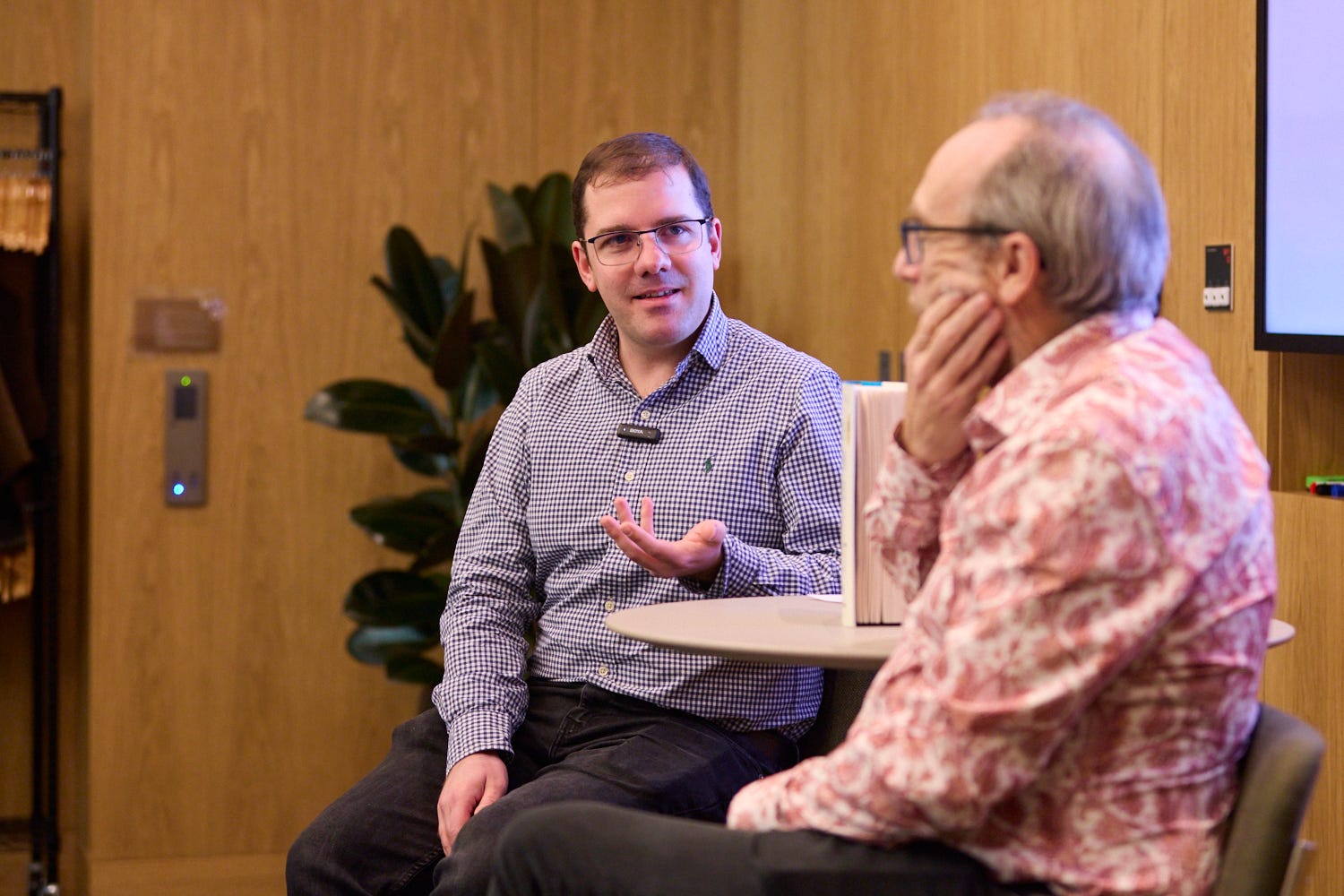
This thought leadership was reinforced at the end of the year by the privilege of interviewing Wikipedia Founder, Jimmy Wales, at a packed London event focusing on the fundamental concept of Trust. For a long time, I’ve been a supporter of the Wikimedia Foundation, and speaking about optimistically building trust beats focusing on the darker corners of the internet.
In between, I’ve been fortunate to speak and advise multiple companies facing challenges relating to their online profile. In particular, the ongoing impact of Generative AI. It’s clear that building trust in a zero-trust communications environment – accentuated by so-called AI slop and political polarisation – will continue to be a corporate challenge in 2026.
Zero-trust on social media is driving fragmentation
Social media continues to go through a catalyst of change. A data partner I work closely with, Pulsar, recently published their report ‘The Great Fragmentation: Navigating the Splintered Web’, showing how audiences, platforms, and behaviours are pulling in new directions. But you could call this phenomenon what it truly is: a mass secession from the truth, propelled by the failure of trust.
Pulsar starts the report by saying,
“We’ve been here before. In the middle of the 20th century, particularly in the US, markets and audiences were concentrated in the hands of a few major players across telecoms, automobiles and personal computing – until they weren’t. Today, the same fragmentation that took place within these industries is happening to social media.”
This ‘fragmentation’ could easily be seen as a visible symptom of ideological distrust. When institutions, governments, newspapers, and the very platforms that host them are viewed with a healthy scepticism, the result is predictable: a retreat. Platform choice is now a form of identity signalling. People are no longer merely choosing a medium; they are choosing a tribe, a belief, and a preferred version of reality.
Take Substack, for example. Pulsar highlights that Substack’s growth has been 65% this year – based on conversations here, this is in part due to a philosophical known that Substack rewards engagement and free speech.
The biggest user growth also comes from Bluesky and Truth Social – two other social platforms with strongly positioned purposes. In contrast, the user base for goliaths such as TikTok and Twitch are falling; Facebook and LinkedIn seem flat. It could be perceived that the masses, refusing to be informed by a single, purportedly objective source, now seek refuge in niche outlets and specialized channels where their existing prejudices are not challenged but celebrated.
Communications professionals with deep audience understanding will need to face how to manage narratives across these splintered grounds; additionally, where to focus shrinking budgets to make the most impact.
Get ready for 2026
If I had to summarise what 2026 will mean for strategic communicators, then it is to witness a paradox: we are more internet-connected than at any point in our lives, yet we are drowning in misinformation, polarisation, and isolation.

Social media has resulted in a society that is neither social nor particularly expert (thanks, AI). Having been burned by the cold, algorithmic indifference of the major platforms, where outrage is the currency, people now crave something that the corporate world, in its infinite clumsiness, struggles to provide: authenticity.
The fragmented communications landscape has curdled the professional tone of voice, which is likely suspected as PR-managed deception. Instead, people crave the personal. People do not want to hear from a “brand”; they wish to hear from a human being, flaws and all. It’s like the social media of 2008 has come full circle for 2026.
This means moving away from the vanity of “broadcasting content” and towards the essential work of community building. Trust is no longer a top-down endowment; it is a bottom-up achievement. It is built in the small –the Discords, the Substack comments, Facebook private groups – where the noise of the mob is replaced by the voice of the person.
The irony is delicious: to be successful in the professional world of 2026, one must become decisively less “professional.” One must be prepared to be personal, to be eccentric, and to be present. We are no longer managing reputations; we are tending to small fires of human fellowship in a very cold, very dark, and very splintered woods. If we cannot provide that warmth, we are merely adding to the chill.
Like many intentions of parents, they are quickly influenced by the actions of their children. In my case, another nappy change is now due. You could say I like to get my hands dirty, both professionally and in my role as dad. Clearly, part of my 2026 challenge will be balancing ‘corp dad’ with ‘dad, dad’.
Merry Christmas.
Congratulations on the beautiful new arrival, Michael, and I hope that you have a very special first Christmas together.