

“Private bar, a dart board, pool table… you know, we used to have all of this” reminisced a tired tech journalist gazing out over London Piccadilly rooftops, “now the money is in PR”. This must have been around 2013, as I genuinely was tasked with arranging a ‘piss-up in a brewery’ for a networking evening with top reporters in London. Fast forward to 2026, and unfortunately, the news business is still facing a persistent army of challenges.
Each month, the Press Gazette ranks the 50 largest English-language news websites, and I fear for my reporter friends trying to survive in these times.
Just three of the 50 biggest English-language news websites in the world saw month-on-month growth in April.
Some 47 news sites saw a decline in global visits compared to March, according to the latest Similarweb data.
The mastheads our parents trusted, and our clients still pay us to monitor and appear in, are still struggling to find a business model that rewards perspectives and news.
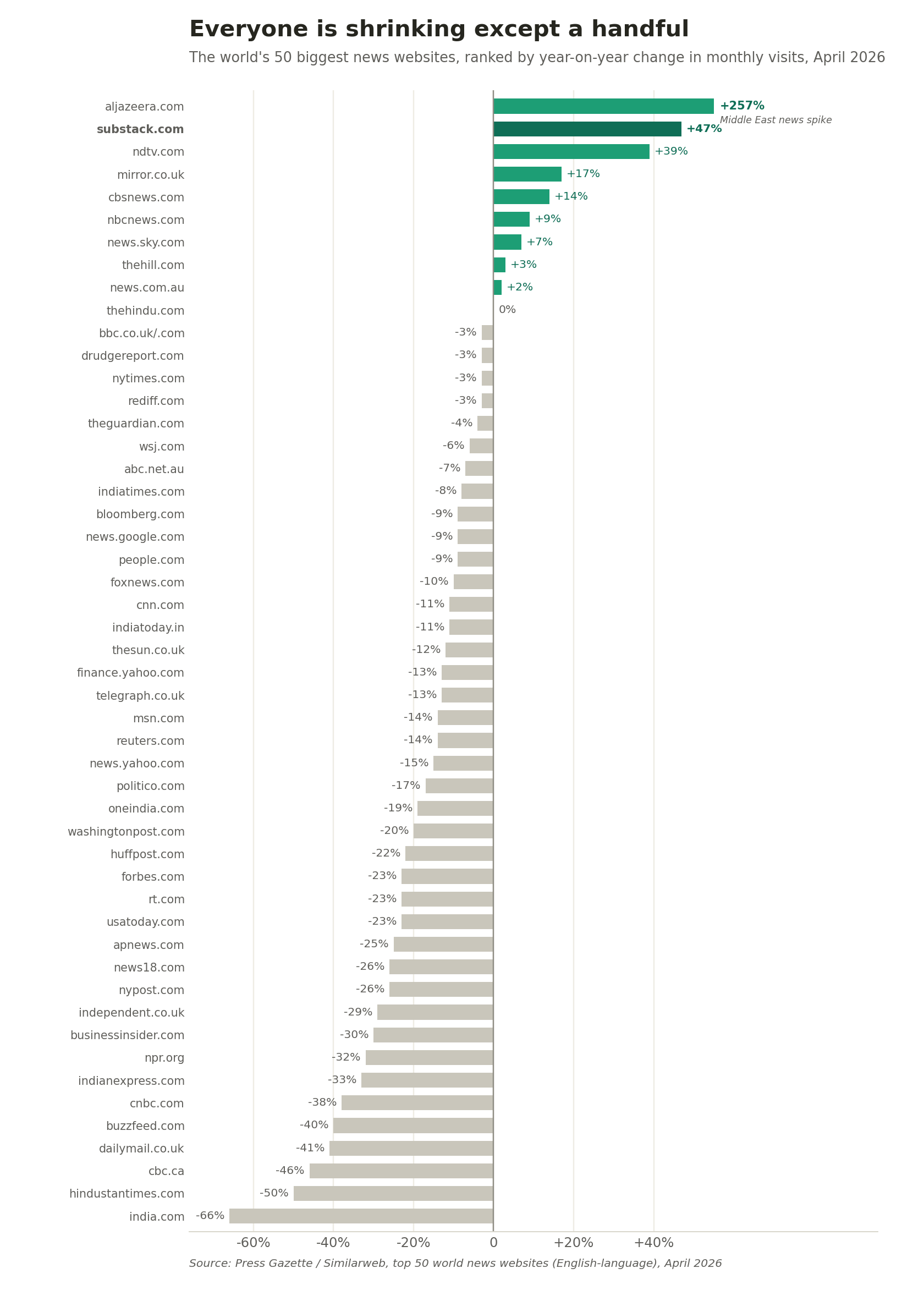
The Reuters Institute‘s annual Digital News Report explains the migration in prose only slightly less funereal than my own: trust in traditional publications eroding, subscriptions stagnating, audiences drifting from the news brands to individual reporters. It’s these days that the columnist, the commentator, the named human with a discernible point of view, matters to readership.
One media brand is going against the grain: Substack. It’s the media brand that boasts growing traffic levels despite having no copy of its own, no large newsroom of reporters, and existing mainly to email other people’s writing to the people who asked for it. Its traffic has climbed from roughly 95 million visits at the end of 2024 to north of 169 million, very nearly doubling at the precise moment the rest of the industry was learning to do more with less.
This may explain why I’m frequently asked by a brand or an executive, “Should we be on Substack? Should I?”
It is a good question, and here is the answer.
I should declare an interest first: this very publication began life as a LinkedIn newsletter called White Space, and I picked it up, subscriber list and all (yes, there is a method…), and carried it over here. So clearly, I have voted with my feet (or my fingers?).
You’re already on LinkedIn
For most of the past decade, the answer to “where should our executive build a profile?” required no thought at all. LinkedIn. Obviously LinkedIn. It is where the professional audience gathers, the networking is frictionless, and the format forgives a great deal.
Then the foundations changed.
Over the last 12 months, LinkedIn rolled out a recommendation engine its engineers call 360Brew - a large language model, reportedly some 150 billion parameters, now deciding what the feed shows you. It reads your actual words, infers what each individual reader privately cares about, and renders a verdict on your relevance. The consequences have been well documented.
Richard van der Blom’s Algorithm Insights study, drawn from 1.8 million posts, found views down 50%, engagement off 25%, and follower growth slowed by 59%. Company pages fared worst of all: organic reach down somewhere between 60 and 66% since 2024, with the average corporate page now reaching around 1.6% of the followers it worked so hard to acquire. You may recall this is a transition Facebook went through around 2016.
Even LinkedIn’s own stars feel the chill. Simon Sinek, Adam Grant and Steven Bartlett command audiences in the millions there, and all three now work a feed that rations attention more tightly than at any point before. However, keep in mind that it’s a personal profile now that earns several times the reach of a company page sharing the very same words.
Now clearly, investing time in LinkedIn is still important as it remains the largest professional gathering on a social network with the backing of Microsoft. However, building a profile on LinkedIn is like investing in a house on leased land and everything has the potential to quickly change. Keeping this homeowner analogy going, there is nothing quite like owning your own place.
What to consider on Substack
Earlier this year I attended an event with Emma Rowley, Substack’s Head of News and Culture UK, to explore what it takes to be successful on Substack.
The room was full, and the air was distinctly hot with communications people - agency and in-house - every one of them circling the very question I now field. You could watch the penny drop as the room understood that the platform has remarkably little interest in the organisation. It wants a person.
For most executives and brands, Substack won’t be right. Mostly as they’re unwilling to do the one thing Substack rewards, which is an authentic human voice that offers a perspective worth considering. If your internal approvals process includes a dozen people and multiple rounds, we all know that the outcome is a piece of polite airline journalism that doesn’t require thought.
BUT, if you are bold, brave, and belligerent (no, really), Substack could work. Have something to say, be credible with it, and let the institutional glaze of responsibility take a slight breather - be willing to connect with people and exchange ideas in a public forum.
Owning your audience has quietly become one of the very few moves in executive communications where the wind is at your back rather than in your face. The inbox, it turns out, is about the last piece of land you actually own. I would think hard about who, in your organisation, deserves to build on it.
LinkedIn vs Substack, the benchmark
Let’s pit both platforms against each other, but they’re very much bedfellows in reality.
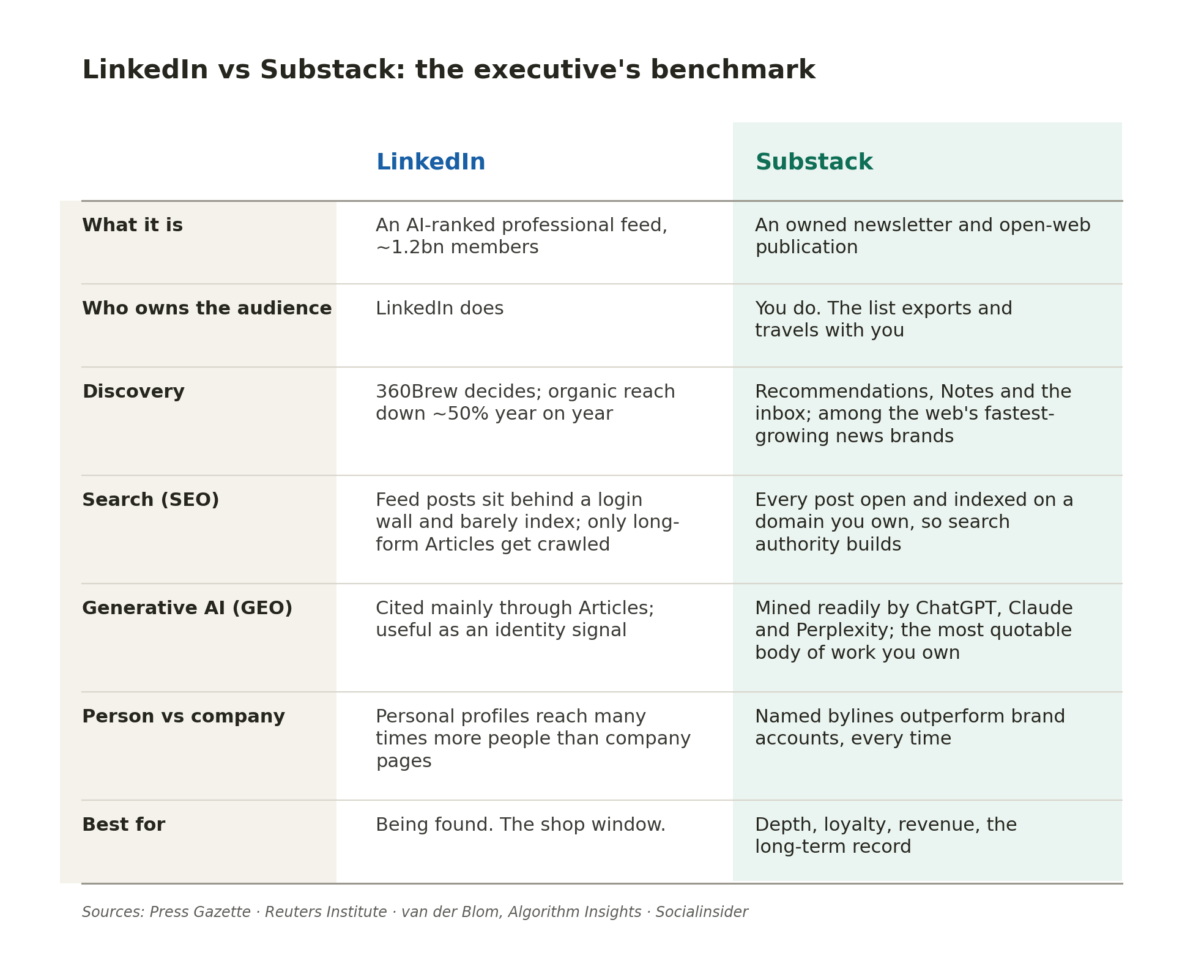
On search, the gap is structural. A LinkedIn post lives behind a login wall and is, to a search engine, very nearly invisible; only LinkedIn’s long-form Articles are reliably crawled and there is a small chance Gen AI responses will surface them. Every Substack post sits on the open web, on a domain you can make your own, indexed and accumulating the topical authority that search rewards.
That second clause is the one most comms teams have yet to price in. When a journalist, an analyst or a prospective client asks ChatGPT or Perplexity “who is the leading voice on X?”, the model answers from what it can retrieve, and it retrieves from the open, indexable, persistent web far more readily than from a walled feed.
The sharpest operators are now building what the Generative Engine Optimisation (GEO) crowd call triangulated authority: a personal site, a LinkedIn presence and a Substack, cross-linked so that an executive resolves, in a machine’s eyes, into a single verifiable expert. An owned, indexable body of work has become a reputational asset in its own right, and a login-walled feed is the wrong place to keep one.
A practical caution while we are here. LinkedIn now suppresses posts carrying external links by something like 40% to 60%, so the old “here’s my newsletter, do click through” play actively backfires. Lead with the idea natively, hold the link back, and route readers across with rather more subtlety than the job used to require.
So… should you, or shouldn’t you?
If the macro case has tempted you, the decision still comes down to a short and unsentimental set of questions. I would not proceed unless your executive clears most of them.
Have they got analysis, or only announcements? Readers subscribe for thinking that sharpens their judgement - a framework, a contrarian-but-defensible view, a lesson from the actual coalface of running something. A press release in a nicer typeface won’t work.
Will they write it, and keep writing it? Cadence is the single best predictor of whether one of these survives. The internet is an ossuary of executive newsletters that launched to fanfare and fell silent by week seven, and a dead Substack speaks louder than no Substack.
Can you let it run free of the sales function? The publications that earn the regard of journalists and analysts read as editorial. The instant yours smells of the pipeline, the credibility that justified the whole exercise evaporates, and you are left with an expensive brochure nobody opens.
Can your sign-off keep pace? Regular publishing needs a review process robust enough to protect the business and quick enough to clear a post within the news cycle it belongs to. Three approvals and a fortnight’s delay will strangle a publication before it draws breath.
Can you live with the comments? A public platform hands your critics a permanent venue, and someone will need to tend it. For an executive with active detractors that is a genuine consideration, though a manageable one if you have planned for it rather than discovered it.
Do you have the time for Substack Notes? It’s widely reported that Substack Notes is the best growth engine for subscribers and views, but it’s akin to managing an old-school Twitter account. You need daily publishing, comment fielding, and open interaction with other authors.
So, what do you think? Ready for Substack?