

With the Mercury primed to burst out the top of the thermometer in London, where temperatures in recent days have hit an alarming 37 degrees Celsius, anxiety was looming as I was about to meet New York Times best-selling author Nir Eyal. His three books (Hooked, 2014; Indistractable, 2019; Beyond Belief, 2026) have collectively sold over one million copies in more than 30 languages.
The occasion was the London leg of Nir Eyal’s tour for Beyond Belief: The Science-Backed Way to Stop Limiting Yourself and Achieve Breakthrough Results, an evening Kekst CNC put on in partnership with the tech community Potato (yes, really, Potato). His latest book Beyond Belief is Nir’s attempt to do for conviction what his other books did for habit and attention.
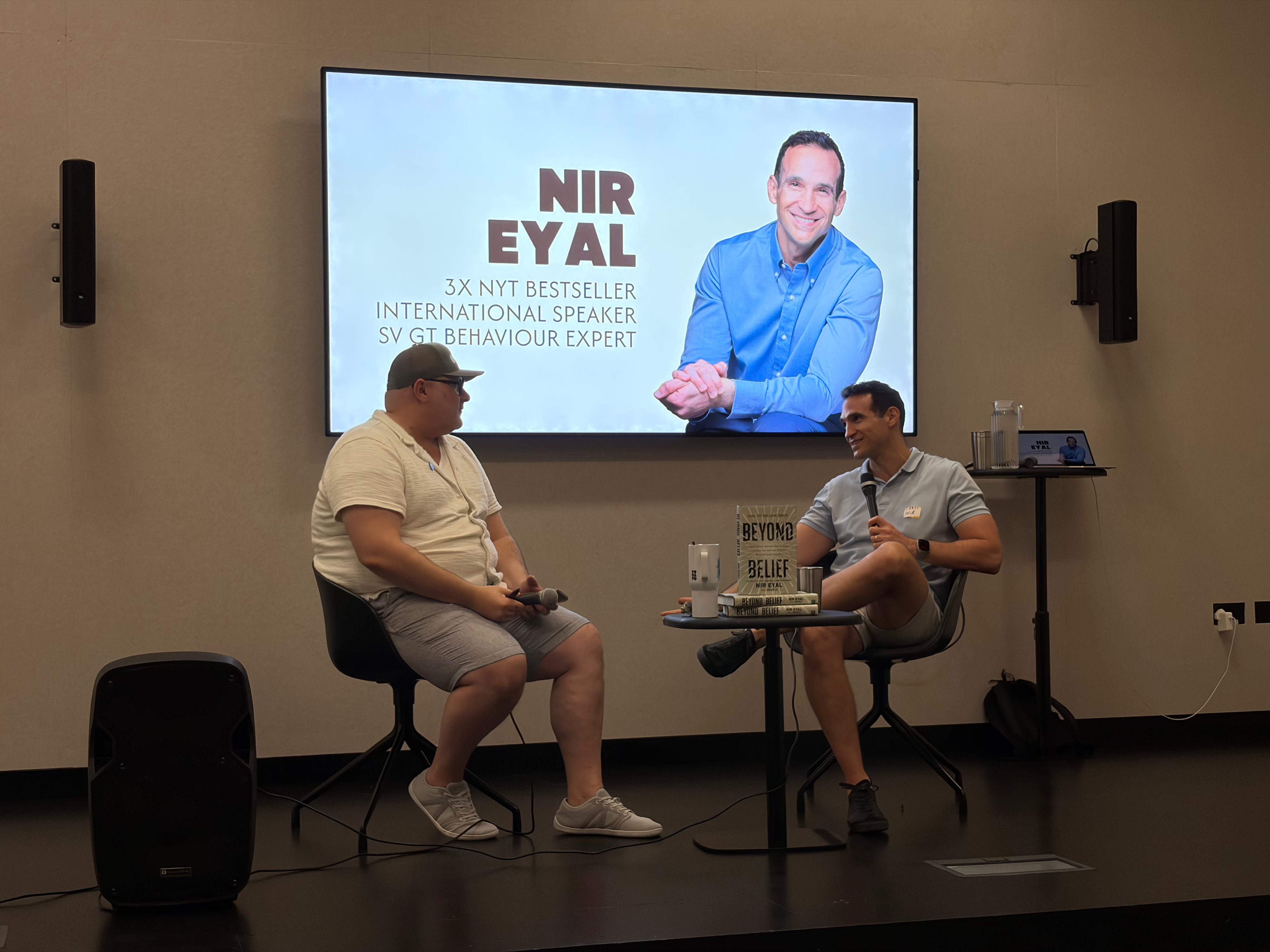
He is the rare author who is exactly as generous and positively caring in person as the words in his book guide. He stayed long after the formal part had ended, working through a queue of readers with no apparent hurry, several of whom had travelled a serious distance to shake his hand, get his views, and have a book signed.
Beliefs are tools, not truths
For readers of this Substack, I know that self-help books are an area of contention - but Beyond Belief is different. It does offer a powerful science-backed argument that the limits you treat as facts about yourself are usually beliefs you have never bothered to question. However, for anyone working in marketing and communications, the book presents useful processes and principles painting what a brand narrative actually is and how they can collapse at precisely the moment they are needed.
Nir explained that we need to separate these three things, which we routinely confuse in our lives:
A fact is an objective truth that holds whether you accept it or not.
Faith is a conviction that asks for no evidence.
So belief sits between the two: a strongly held conviction that remains open to revision when the evidence shifts.
Most of our trouble comes from collapsing the distinction, treating our faith as fact and our beliefs as facts, and then defending all of it as though reality were at stake. For communicators, a great deal of what a company and its stakeholders solemnly call “the facts” are beliefs in disguise, and beliefs, unlike facts, can be worked.
The ‘lie’ inside Belief
The line that drew the loudest murmur of recognition was the simplest. Look, Eyal said, at the word itself. There is a lie sitting in the middle of belief. A belief does not have to be true to be useful. It only has to work.
A purpose statement, a positioning line, a set of values bolted to an office wall: none of these is a fact in any meaningful sense. They are instruments, and the only honest question to ask of them is whether they move people in the direction the business needs.
Nir reached for Amazon as his worked example (based on an ex-Amazonian sitting in the audience). One of the company’s founding internal beliefs is that it is always Day One. This is obviously nonsense. Amazon is a vast, mature, institutionally fortified machine, and it has not been on its first day for decades. As a tool it is close to priceless, because a company that genuinely believes it is still scrappy and still at risk behaves like one, and a company that believes it has arrived may find its energy sapped away.
Reputation is a belief held by other people
Start with what a reputation is. If beliefs filter what an audience notices, feels and does, then a brand reputation is simply the belief a stakeholder already carries about your organisation. That is the asset communicators manage, and it explains why disclosure on its own so rarely repairs trust.
We tend to behave as though the facts, once released, will speak for themselves. They never do. The facts arrive, and the pre-existing belief decides what they are permitted to mean. Nir put a number on the gap between what reaches us and what we register: the brain takes in something like 11 million bits of information a second and consciously attends to roughly 50 of them. We see more of what we already believe and screen out the rest. Pour more facts, more proof points and more content into that system and you change very little, because the belief doing the filtering has not moved. The work is on the filter, not the feed.
The real test is what a brand stands for when it costs something
If a belief is a tool, then the test of it is not whether you can recite it on a good day. The test is whether it holds when it costs you something. Nir’s point aimed at organisations is that companies go wrong at the exact moment they abandon their beliefs. Everyone is a person of conviction when its easy to do so. The interesting question is what gets quietly dropped when a situation becomes challenging: when the regulator calls, when the share price moves the wrong way, when the easy thing and the stated value point in opposite directions.
The gap between the belief a company professes in its annual report and the belief it reveals under pressure is, more or less, the entire territory in which reputations are won and lost. A value that is jettisoned the moment it becomes expensive was never a belief.
We treat a crisis as a contest over facts, a scramble to establish what happened and in what order. It is that, and it is a belief test first. The most common failure I see is the one Nir describes, as learned helplessness: the retreat into a defensive crouch, the decision to go quiet, say nothing and wait for it to pass. It feels protective. It is usually corrosive, because silence is read, fairly or not, as the absence of any belief worth defending.
Why a vague brand narrative is no narrative at all
There is a fashionable counsel of caution abroad at the moment which holds that, in an age of permanent uncertainty, the smart move is to commit to as little as possible. Hold every position lightly. Keep the narrative vague enough that nothing can later be held against you. I have argued before on White Wiki that uncertainty is exactly the condition under which communicators should be saying more, not less, and Beyond Belief sharpens the point.
A belief held so loosely that it survives any circumstance is not flexibility. It is the absence of conviction wearing flexibility’s clothes, and audiences can smell it from a great distance. The organisations that come through a hard year with their reputation intact are not the ones that believed nothing and therefore risked nothing. They are the ones that chose their beliefs deliberately, in advance, knowing what those beliefs might one day cost, and then paid the bill when it came due.
The beliefs worth holding are the ones that make you sweat
Which brings me back to the taxi. Eyal is fond of the line that everything worth having sits on the other side of discomfort, and that the trick is learning to manage the discomfort rather than wait for it to lift. I cannot pretend that an hour in a sweatbox on snail-slow London roads taught me anything profound about the human condition. But it is a serviceable reminder that the beliefs worth holding are precisely the ones that occasionally make you sweat. Perhaps the brands that survive the test of time do the same.
If you found this article thought-provoking, then you can buy Beyond Belief here.