

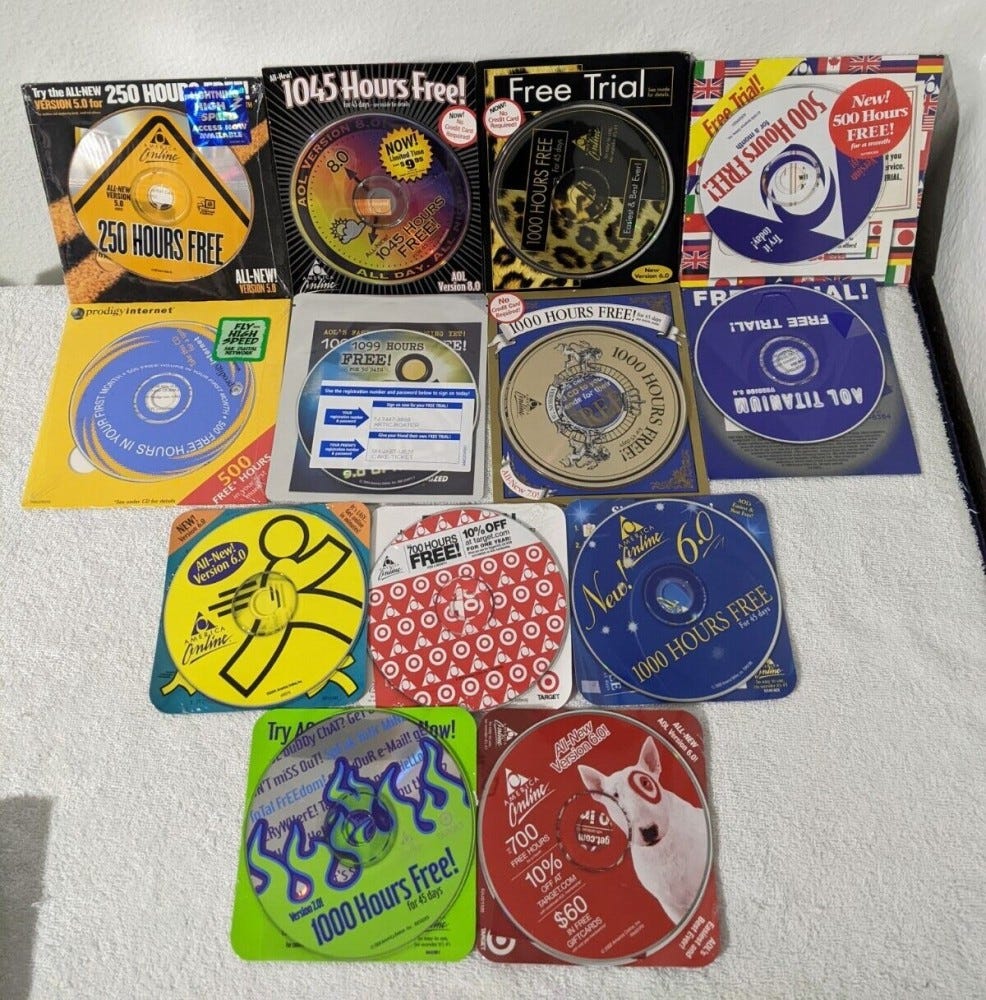
The iconic America Online (AOL) trial CD can be purchased as a vintage item on eBay for just £8 today. Originally used as part of AOL’s marketing campaign to sign up customers for their dial-up internet service, those eBay prices may soon soar as AOL will discontinue this service at the end of September 2025. That’s 34 years after dial-up was launched, but AOL gave us something else: a new way to approach online communications.
They recognised that effective online communications is achieved by engaging online content and community discussion. This drew criticism from Lawrence Lessig, an internet theorist who criticised this closed model as a threat to the open nature of the internet. Although AOL’s 14,000+ network of volunteer editors and moderators could be seen as akin to an open-source movement, this was 5 years before Wikipedia launched in 2001.
It wasn’t until the late 2000s – 2010 that AOL began hiring hundreds of journalists, editors, and videographers to support its “content-first” business model, using data-led strategies to inform editorial decisions. The insights, strategies, content approaches, and measurement have arguably influenced how firms run their online marketing and communications to this day.
Gen AI and bots are changing the internet
It’s a strange coincidence that at the same time AOL closes its dial-up service next month, we’re seeing the online communications formula it started also reaching a transformative phase, caused by bots and changing search behaviours.
There are now an alarming number of bots on the internet. The cybersecurity company Thales latest report shows that bot traffic has now surpassed human traffic. Many of these bots are useful, enabling reputable services to run by crawling, monitoring, and scraping online content. Generative AI platforms deploy the likes of AppleBot and ClaudeBot to source references for responses. It’s part of a growing Bots-As-A-Service (BaaS) commercialisation of the internet.
Parallel to the bot boom is a behavioural shift in human search behaviour. According to Bain & Company, 60% of Google searches now end without a click, and 80% of people rely on “zero-click” results in at least 40% of searches. Since the publication of this report, Google has also launched AI Mode that will further drive behavioural change. Pew Research states that a worrying 26% of people end their browsing session entirely after viewing an AI summary.
This commercial impact feels like a betrayal by Google
The impact is being felt by business, especially when it comes to shaping online reputations. Only one company I’ve spoken to in the last 6 months has claimed ChatGPT is an important referral source for their business, but I do wonder if this has been filtered for bot activity.
Google will argue that traffic is being redistributed to high-quality online sources like forums and videos. For companies, this redistribution can feel more like erosion, and means shaping narratives and pushing marketing requires a revised approach. Online publishers have reported traffic declines of 70% or more, and behind the scenes, corporates are trying to understand how to best adapt to this new search landscape.
Ironically, companies that have well-optimised ‘traditional’ traffic model websites may be feeling the pain the most. A successful content strategy will likely lead to bots crawling the website effectively and serving results to Gen AI. Whilst this may mean messages are still reaching audiences, companies that need this website traffic for conversion may see a loss of visibility, engagement and revenue (which is why publishers have been so vocal).
Transform or be left behind
It means your online communications strategy needs reviewing fast, as the progression of Gen AI will correlate with how companies and executives are profiled online. In the short term identify how bots could be distorting your analytics, what your latest audience preferences and journeys are showing, and use insights to inform your active communications strategy.
AOL’s transition from a tech utility provider to a content hub was a masterclass in engineering the internet for human experiences. In these times of change, it’s worth considering what AI can’t offer. Perhaps that’s an experience…
The post More bots and fewer clicks: why your communications strategy needs rethinking appeared first on White PR.