

Half today’s marketing workforce will be gone by 2030. What do you think? That was the motion put to a room in Portcullis House last week.
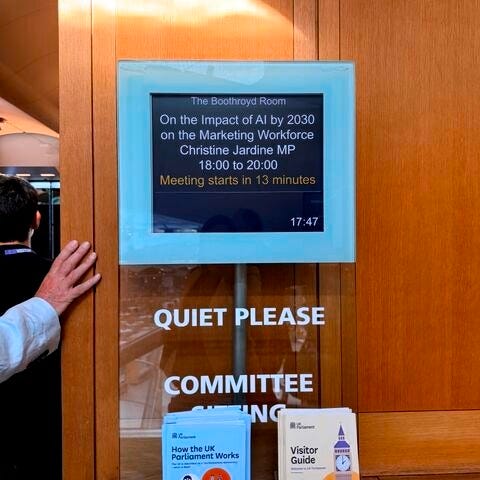
Being in the heart of Government is a privilege and an experience. It’s only in a place like Portcullis House that you can find yourself in a conversation about the previous defence minister, only for him to randomly walk past: John Healey, by the way. In the Top Trumps of Government though, this was soon exceeded by Andy Burnham walking past our committee room outside, the day before the Labour Leadership nominations open, now we know to have been a ‘coronation’ as a clear winner and to be Prime Minister within weeks.
Then into the room, to debate whether AI is about to gut a profession, while the country’s next government was more or less re-assembling itself down the hall.
The motion: by 2030, advances in AI will render half today’s marketing workforce unnecessary, forcing a redefinition of marketing.
Chaired by Christine Jardine MP, hosted by The Debating Group. Both sides ended up standing closer together than the motion admitted (which usually means the motion was never quite asking the right question…).
The funnel is already dead
Here is what is actually changing, and the debate kept dancing round it instead of naming it. Search is becoming answer. Browsing is becoming delegation. The whole neat customer journey marketing built its industry on, top of funnel to bottom, brand-controlled and linear, only worked because a human was doing the searching and the comparing. Increasingly it is an AI agent doing that on the person’s behalf, before the brand gets so much as a glance.
Marketing organised itself around campaigns and channels because that suited a world with a controlled path from awareness to purchase. Take that path away, and the org chart stops making sense. What has to replace it is a discipline organised around intent, trust and judgement, because those are the three things an agent cannot fake on a client’s behalf.
This debate was never really about AI
Nobody arguing for the motion thinks AI makes marketers pointless. The argument is that AI removes friction, and a lot of what a marketing job title covers today is friction: manual production, duplicated content, reporting nobody reads twice, approval chains longer than the campaign they are approving. Friction gets automated. That is not up for debate. What is up for debate is whether the purpose of marketing survives once the friction that once justified half its headcount disappears.
I sat there thinking this is my industry’s argument too. Strategic communications has spent the last decade insisting that reputation is not a campaign output but a governance discipline, built on consistency and judgement rather than the volume of activity. Marketing is now having that exact fight with itself. The two professions are converging from opposite directions on the same conclusion: the work that survives is the work that protects trust with an audience, and everything else was always just busywork with a job title attached.
But busy was never a strategy. It was just easier to put in a deck
The best point made against the motion was that marketing was never a pile of tasks in the first place. It is market understanding, positioning, insight, commercial judgement, the ability to actually shift how people behave. None of that is something AI does. All of it is something AI speeds up. Marketing activity and marketing value are not the same thing, and that gap is where this whole debate actually lives, whichever way the vote went.
It also kills the idea that “AI-enabled” is a strategy on its own. Everyone using the same models trained on the same data gets the same output. Average, writing average copy for an average audience. Real advantage was never going to come from the tool everybody has. It comes from the call that looks mad on a spreadsheet. Nobody ran the numbers before putting a gorilla behind a drum kit to Phil Collins. No model would have signed that off. It is one of the most effective ads British advertising has ever produced, and it exists because someone was willing to be irrational.
Authenticity is about to get expensive
Fill the open internet with AI-generated content and the premium shifts to whatever obviously could not have come from a model. A point of view. A name attached to a risk. Marketers spent a decade being rewarded for scale. The next decade rewards the instinct most of us actually had before scale became the metric, the one we got told off for early in our careers for being too weird or too off-brief. Out of the box thinking is about to stop being a cliché on a CV and start being the actual job again.
The people at risk are the ones nobody built a strategy for.
Where the motion has a real point is reskilling. A lot of marketers built careers inside one channel: paid search, one platform’s social output, production work valued for throughput rather than judgement. Those are the roles most exposed, not because AI is out to get anyone, but because throughput is exactly what AI is fastest at. That is the actual redefinition on the table. Not headcount, but which skills a marketing career gets built on from here, and CIM’s own definition of the profession is going to need revisiting alongside it.
Banksy uses an aerosol can.
Best line of the night. Nobody argues Banksy is not an artist because he uses a spray can instead of a brush. Different tool, same craft. AI is the spray can. The judgement about what is worth saying, and to whom, is still entirely human, and it was always the actual job under the job title.
Why this matters past marketing.
I do not think half the marketing workforce disappears by 2030, and clearly the room also agreed at the end of the debate. What AI does is force a separation the profession has been avoiding for years, between people who manage activity and people who create commercial and reputational value. That separation is not unique to marketing. It is the same argument strategic communications has been having with itself, and it is why the two disciplines keep turning up at the same table.
What actually stayed with me leaving Portcullis House was not the vote. It was the size of the thing this one debate was a small piece of, and the fact that the man most likely to be running the country’s economy within weeks was in the same building while it happened, perhaps entirely unaware it was happening.
A profession employing hundreds of thousands of people in this country is being restructured by technology that most of Parliament has not properly grappled with, and marketing is only the visible edge of it. If AI genuinely changes how a meaningful share of the economy buys, sells and hires, that is not an industry conversation CIM should be having on its own in a committee room down the corridor from where the next Prime Minister is being decided. It is a conversation that next Prime Minister needs to be having, because the tax base, the employment figures and the skills pipeline all sit downstream of the same shift.
Thanks to CIM, The Debating Group, Christine Jardine MP, and the four speakers.