A warning before we start: this blog, newsletter (whatever you want to call it) is a long one. London Tech Week 2026 inspired a multitude of thoughts and perspectives useful for communications – shortening would have been a disservice. Make a coffee.
The story of London Tech Week 2026 rested on two themes: capital and sovereignty. Let’s start with the capital…
London Tech Week launched with a fanfare of announcements.
£2 billion: AMD’s commitment to the UK over the next five years.
£1.7 billion: Nebius committed to building out AI capacity in the UK.
£400 million: Sir Keir Starmer used his keynote to set out a national compute strategy, including to buy specialist AI compute, alongside a wider AI hardware plan worth around £1.1 billion across chips, compute and skills announced by the Technology Secretary.
£45 million: Lord Vallance announced the Engineering Biology Value Chain Growth Fund, on top of larger sums for research and scale-up infrastructure.
£12 million: Mayor of London, Sadiq Khan announced investment into helping London’s small firms adopt AI, and published a City Hall report warning that requests to connect new data centres to the capital’s grid already run to roughly ten times the power those centres draw today.
An accountant for UK PLC may say these investments build the resilience necessary to cement Blighty in Europe’s so-called “decisive decade”.

Then on sovereignty, this was a full-on informal state occasion. The Prince of Wales joined a panel on using data to spot the risk of homelessness before it arrives, and his Homewards initiative launched a Homelessness Data Lab. The Mayor of London launched a programme of his own. The Prime Minister opened London Tech Week, as he did last year. The Science Minister attended, the Minister for AI, the list was quite endless… even the Director of GCHQ – an eagle-eyed observer would spot discreet security with earpieces.
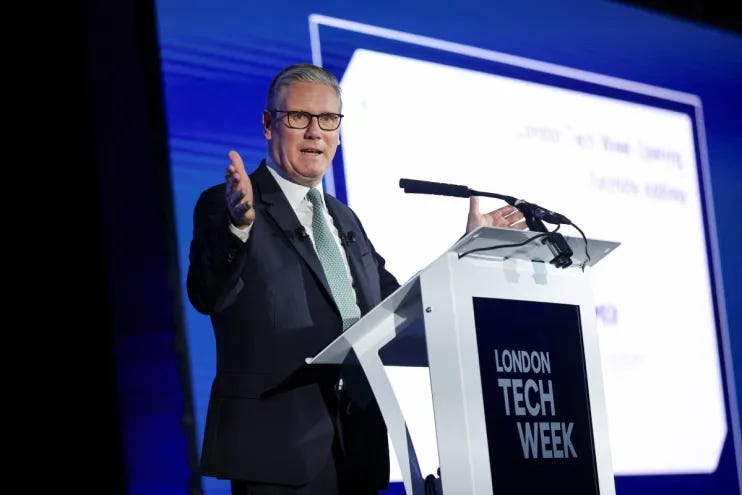
So the two forces, sovereignty and capital, and what they mean for us humble communications practitioners.
The first force: sovereignty
Digital sovereignty is a grand term for a series of basic questions. Who owns the compute, the energy, the data centres and the data that artificial intelligence runs on? Who sets the terms for everyone else who uses them?
Sovereignty is multidimensional, and every country defines it to suit its own geopolitics, economy and security. The United States, the European Union and China hold three competing philosophies, written into the US CLOUD Act, the GDPR and China’s data security regime, and most other nations arrange themselves somewhere along that spectrum.
The sharpest version on stage came from Judith Dada of Visionaries Club, on a panel with the AI minister Kanishka Narayan, HPE’s Matt Harris and George Osborne, the former UK chancellor who now runs OpenAI’s work with governments. Dada argued that the prize is owning the bottlenecks that confer leverage, and noted that Europe holds a sliver of the world’s AI compute capacity, compared with roughly four-fifths in the US. Osborne made the realist’s case, that trying to own every layer of the stack is a fool’s errand, and that a country should aim to be indispensable rather than self-sufficient.
The consensus, once you strip away the rhetoric, is quietly pragmatic. No country is going to build the entire stack itself. Complete independence is neither affordable nor desirable, and a home-grown system would struggle to keep pace with the frontier. The serious goal is leverage and flexibility: control over the parts that matter, and the freedom to move when the politics or the economics shift. In practice, sovereignty is a negotiated set of options. The fortress was always a fantasy.
And it is not only a question of hardware. A sovereign capability is worth nothing without a workforce that can use it and a public that trusts it. Skills, adoption and public confidence sit alongside compute and data as conditions of the same independence. A nation, or a company, that owns the infrastructure but cannot carry its people with it has bought a tool it cannot lift.
The second force: capital
The second force was quieter on the main stages and more honest in the numbers. Britain is brilliant at building companies and less good at keeping them. The figures in this year’s Tech Nation report are strong. UK AI start-ups raised £8.2 billion in the first half of 2026, the country took close to half of all European tech investment, and the wider tech sector is now valued at around £1.2 trillion.
Read the same report a page later and the catch appears. Roughly fifty-seven pence of every pound made on an AI exit flows back to the US, with only nine pence staying here, and about one in two venture dollars invested in British AI arrives from across the Atlantic. The British Business Bank’s chair, Stephen Welton, spoke about scaling deep tech, which the UK has learned to do well. The harder problem is ownership at the finish line.
The example everyone knows, and few said aloud, is DeepMind. A London company, co-founded by Demis Hassabis, who by his own account wanted to keep it in London, sold to Google in 2014 for a reported £400 million because it needed the capital, the data and the computing power to stay at the frontier. The capital and the bottlenecks were in California, so in time the ownership, and the value, followed them there. The company still sits in King’s Cross; the cheques are signed in Mountain View.
That is the moment the two forces become one.
Whoever owns the compute and writes the cheque tends to end up owning the company, and with it the story of where the value was made. Mayor of London, Sadiq Khan was candid about the gravity… London has reclaimed its place as Europe’s leading tech hub and yet talent is mobile and can leave for Lisbon, Milan or Silicon Valley without much ceremony. AMD’s £2 billion and the growing London offices of OpenAI and Anthropic are welcome, but we’re currently a river that flows west.
The floor told the truth the stages skipped
Like last year’s London Tech Week, the expo floor – which I’ll certainly enjoy not experiencing for another year(!) – was full of conversations that coloured the corporate and state announcements. A good share of the stands belonged to other nations, each pitching itself as the place to incorporate, relocate and start again, their branding aimed at arrivals more than at home-grown firms with traction looking to expand.

The stage said build here. The floor said come and start over there.
Sovereignty at street level is a daily decision taken by founders and capital that can always choose somewhere else, and capital, as we have seen, usually has a view on the matter.
Regulation as a sovereign asset
Regulation itself can be a sovereign asset. British law firms were held up as leading adopters because the UK lets them experiment where the US does not. The medicines regulator may become the first in the world to license a gene therapy whose trial data showed it slowing Huntington’s disease progression by three quarters, data the American regulator has so far declined to accept. Owning your own rules, and using them with nerve, is a form of sovereignty that needs no hyperscaler’s budget. Although I’m not sure I want to be in a country known for rules over innovation – Keir Starmer’s opening speech didn’t help with that.
Sovereignty is a communications challenge
Everything is about communications, especially at a London Tech Week when capital and sovereignty are locking horns with one another. The questions a state now asks about compute and capital are the questions I hear from businesses every week. Here are five communications aspects to consider:
Every company needs a position on the sovereignty debate and decide if that needs to be public. For a growing number of companies, the debate is unavoidably public; if you run critical infrastructure, hold sensitive data, sell to government, operate a UK arm of a US parent, or depend on a single foreign platform, your customers, regulators and staff increasingly expect a view on where your technology comes from and who controls it – you must be prepared. This has already moved from reputation into disclosure. AI governance now appears in proxy statements and annual reports, investors expect boards to explain how AI is overseen, we even see this in those lengthy and tedious agency RFP processes. AI risk has joined cyber and supply chain as a standard line in corporate reporting. Of course, silence is a position as well, but you’re only really delaying the inevitable.
Know where your data lives, and who can compel access to it. The whole industry is fixated on which model to use. Far fewer leaders can say which jurisdiction holds their data, which sub-processors touch it, whether their providers train on it, and how much contractual freedom they have to move it. The lesson from the sovereignty debate is that location has stopped being the point. A data centre in Paris run by an American operator can still fall under American law. Control is the asset, and geography no longer guarantees it. For a communicator, that is a governance question with sharp reputational and disclosure edges, and the one most likely to surface in a regulator’s letter, an investigative piece, or the answer an AI system gives about your company.
Do not promise an independence you cannot deliver. The honest national lesson, that no one builds the whole stack alone, holds for companies too. Trying to engineer your own sovereign capability is expensive, hard to maintain and destined to trail the frontier. The credible story is flexibility: a setup built on solid foundations, with the optionality to change supplier, jurisdiction or model when you need to. Retire the sovereignty theatre and describe the real posture, which is pragmatic dependence held under firm control.
Remember that the machine is now a stakeholder. Your reputation runs partly on infrastructure you do not own, and the most important reader of your words may be generative AI. The answers across the prompt lines of Claude, ChatGPT, Perplexity, and so on, describe you to buyers, journalists, investors and regulators. They read what you publish literally, and they repeat their account of you to everyone who asks. Clarity and verifiable evidence are now the price of being described correctly.
Make your employees and your broader stakeholders part of the story from the outset. The sovereignty debate keeps returning to skills, adoption and confidence, and so should your communications. The internal narrative, how your people are trained and brought along, and the external one, why the public should trust what you are building, carry as much weight as any infrastructure announcement. Capability that no one understands or trusts is not capability at all.
So what did I learn from London Tech Week 2026?
AI has turned infrastructure into politics, and politics into a capital requirement, and communications now sits where the two meet. Strip the week back and the discipline for any company is three questions. Where do you stand on who controls the technology you depend on, and is that position ready to be public? Where does your data live, and who can compel access to it? And who tells your story when you are not in the room, whether that reader is a regulator, a journalist or a machine?
Someone always owns the thing, and someone always tells the story of who owns it. Your only choice is whether that someone is you.