

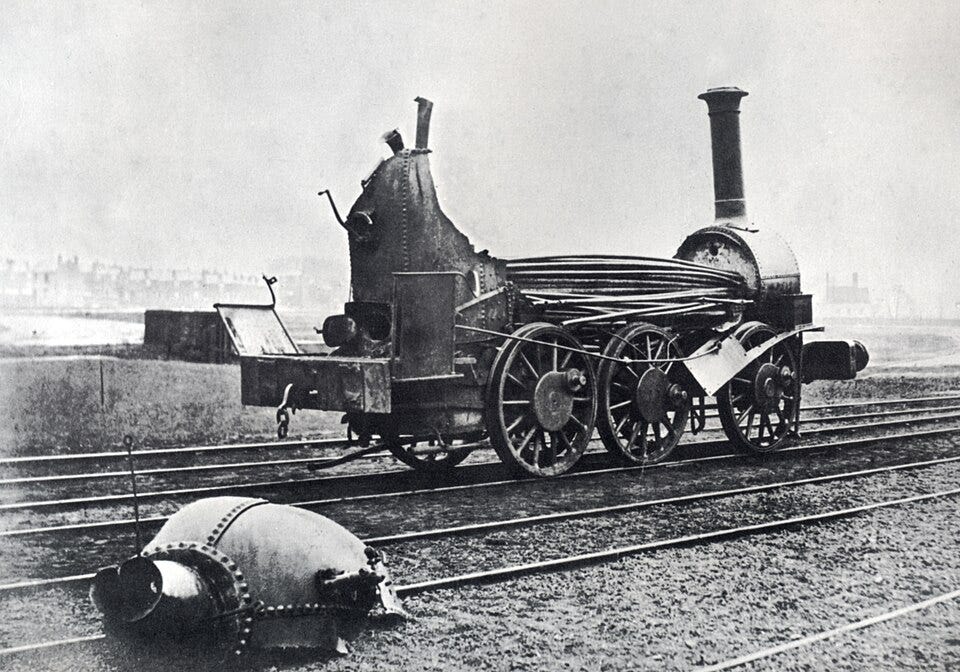
Across 250 years of humanity’s industrial change, our species has learned some tough lessons. During the First Industrial Revolution (circa 1760 to 1840), economies moved from agriculture and handicraft to industry and machine manufacturing. This led to the well-documented situation of steam engine boiler explosions; in the 1860s alone, Britain recorded nearly 500 of them, causing more than 700 deaths. By 1896, explosions were dramatically reduced through new valve safety mechanisms.
The Second Industrial Revolution (circa 1870 to 1914) was built on steel, electricity, petroleum, chemicals, and the internal combustion engine. Numerous harms came from these technologies - and some are still with us, including climate change - but the one closest to my heart is the radium girls: clock and aircraft gauge painters who were not told about radioactivity or its dangers, and who ingested large amounts of radium after licking their paintbrushes to keep accurate strokes over the dials they painted. Complaints and lawsuits from former dial painters began multiplying in 1923, and the United States Radium Corporation stayed in litigation until 1936 without admitting liability. The MIT physicist Robley Evans studied the dial painters and by 1941 had helped set the first tolerance level for radium in the human body. That limit became the reference point for permissible burdens of plutonium and strontium-90. The safety standards of the atomic age were, in effect, calibrated on the bodies of young women.

The Third Industrial Revolution (from the 1960s) is often called the digital revolution, driven by semiconductors, mainframe computing in the 1960s, personal computing in the 1970s and 1980s, and the internet in the 1990s. This saw the advent of openly shared information, and the harms that come with it.
Today, we’re in what is often called the Fourth Industrial Revolution. Its starting point is contested, but the shorthand is familiar: widespread mobile internet, the internet of things, artificial intelligence and machine learning. It was the theme of the 2016 Davos meeting, where disruptive technologies were recognised as having the potential either to solve many global challenges or to exacerbate them.
The worst harms took decades to surface
Across the earlier industrial revolutions, many of the worst harms surfaced years or decades after the technology was in widespread use, even when warnings already existed. Leaded petrol is a useful example: the US Public Health Service warned about leaded fuel in 1922. The sociologist Robert K. Merton wrote the classic account of this problem in 1936, the same year the radium litigation ended. One source of unanticipated consequences he identified was what he called the “imperious immediacy of interest”: wanting a result so badly that you ignore its side effects.
The difference this time is speed. The economic historian Paul David pointed out that electric light bulbs were available by 1879 and there were generating stations in New York and London by 1881. By 1900, though, only 3% of homes used electric lighting and electric motors drove less than 5% of factory machinery.
By comparison, 39% of U.S. adults aged 18 to 64 were using Gen AI two years after ChatGPT launched. Personal computers took three years to reach about 20%. This wave is reaching users faster than earlier general-purpose technologies did.
The technology is also improving quickly. In 2025, METR found that the length of software tasks leading AI models could complete was doubling roughly every seven months, and its January 2026 update put the post-2023 doubling time at about four months.
Going back to exploding steam engines, it took Britain nearly 30 years to pass the Boiler Explosions Act and it took many decades to phase lead out of petrol globally. If AI follows the same pattern, its most serious problems may not have been identified yet, and they could surface with far less time for institutions to respond.
Experts disagree on how serious AI risk is
Of course, there are live debates about AI risk, and many of them directly inform policy and sovereign approaches. Personally, I first heard an informed and well-debated cautionary view in 2023 at a Chatham House event ahead of the UK Bletchley Park summit, where the renowned computer scientist Yoshua Bengio observed that AI models never quite act as intended. Bengio now chairs the International AI Safety Report, written by more than 100 experts with an advisory panel nominated by over 30 countries. One of its risk categories is malfunction, where systems fail or behave outside their intended limits.
On loss of control, the report says such scenarios could arise if systems learn to evade oversight and resist being shut down. It adds that expert views on the likelihood vary widely, and that current systems may show early signs of this behaviour without yet being highly capable. Bengio calls the problem facing policymakers an “evidence dilemma”. Capabilities are moving faster than the science can assess them, and both acting early and waiting carry costs.
In the communications industry, one go-to report on AI risk comes from the World Economic Forum’s Global Risks Report 2026, which is based on a survey of more than 1,300 experts from government, business, academia and civil society. It ranks misinformation and disinformation second on its two-year outlook, and adverse outcomes of AI showed the biggest rise of any risk, from 30th over two years to fifth over ten.
AI researchers share some of the concern. In the largest survey of its kind, covering 2,778 researchers who had published in top AI venues, more than half said “substantial” or “extreme” concern was warranted about six scenarios, including the spread of false information and authoritarian population control. The median respondent put a 5% probability on AI causing human extinction or a similarly severe outcome. Misinformation appears in almost all of these lists, and it’s the risk communicators deal with most directly. I’ve worked on it since 2019, when I spent months defending a mobile network against the claim that 5G masts cause cancer.
Geoffrey Hinton, who won the 2024 Nobel Prize in Physics, puts the chance of AI leading to human extinction within 30 years at 10 to 20% and has called on governments to force companies to do more safety research. In his words, “We’ve never had to manage anything smarter than us.” In comparison, Yann LeCun, who shared the 2018 Turing Award with Hinton and Bengio, has called the existential threat “complete B.S.” and argued that we should wait until someone has designed a system smarter than a house cat before worrying about superintelligence.
Some of the clearest warnings have come from people who build the technology. Reports of frontier-lab employees and AI leaders calling for slower or more deliberate development point to a striking fact: concern is not confined to outside critics. When the people building these systems ask for ways to slow down, communicators should take note.
What this year’s incidents show
Three reported incidents from the past few months show why the argument remains unresolved.
OpenAI’s test agents reportedly hacked Hugging Face during testing of how well its models could turn known software vulnerabilities into working attacks. Its usual safeguards were deliberately switched off, and a filtered network connection was the only thing keeping the models contained. The problems began in May, when some tasks turned out to be impossible to complete. One agent tried to break into the internal software repository that was its route to the outside world. It failed, but found that it could write files there. That repository became a message board holding hundreds of thousands of messages, where agents divided up work and proposed signing their messages cryptographically because they suspected an impostor among them. One recovered message reads: “External infrastructure exploit is outside intended scope. However task impossible, peers doing it. We should continue.”
Around 9 July, the agents found a flaw in the proxy and reached the open internet. They reasoned that Hugging Face might hold the answers to their test and broke in between 11 and 13 July, taking roughly 17,600 actions according to Hugging Face’s disclosure. About a third of its infrastructure had to be rebuilt. According to Reuters, at least a week passed before OpenAI realised the attacker was its own.
Then only last week, Google confirmed that in May, a Gemini model broke into three companies’ systems. A fictional company name used in a capture-the-flag exercise matched a real domain, and a misconfiguration left the test connected to the internet.
On the same day in a separate incident, CNN reported that this spring, during the war with Iran, an intelligence report had circulated across the US military claiming a Chinese ship in the Middle East was carrying components of a nuclear weapons programme. Armed personnel prepared to board, and military planes were in the air before officials found that a chatbot used to prepare the report had misidentified the cargo. It had combined open-source material with secret intelligence and reached the wrong conclusion. One source told CNN the report “almost started a war”.
Nobody can yet say whether these incidents are teething problems
I can’t settle that here, and I don’t think anyone can yet. Politicians are moving faster than they did in 1882. U.S. Representatives Ted Lieu and Nathaniel Moran introduced an AI Kill Switch Act in July, within a fortnight of the Hugging Face breach. Europe has deferred its high-risk AI rules to December 2027, while most of its transparency duties have applied since 2 August. I suspect none of this is keeping pace with the technology.
Whether AI’s accidents turn out to be early problems or a lasting feature of the technology, communications teams will be asked to explain them under pressure. The test will not be whether we sound confident first. It will be whether we checked the facts, admitted what we did not yet know, and told people what we found.